
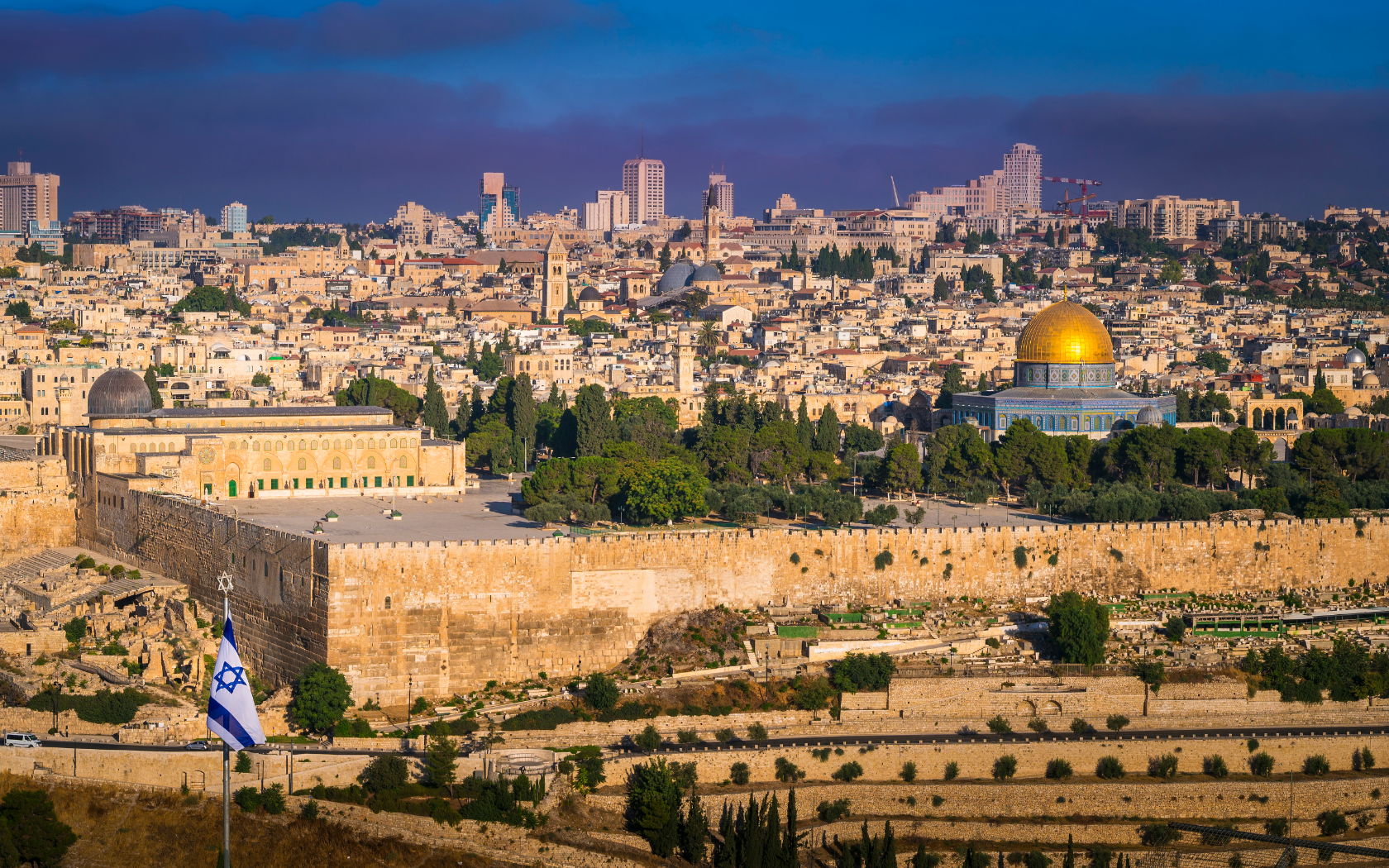
Psalm 122 calls people to 'pray for the peace of Jerusalem' and to seek her good (vv. 6, 9). Is the psalm calling us to be politically pro-Israel, as some people interpret it today? Or is it teaching something more basic to your walk with God?
What is the psalm saying?
The psalm is an ode to Jerusalem as the spiritual and political capital of the nation of Israel. Taken literally, the psalm tells readers to hold Jerusalem in their hearts, pray for her peace, and seek her good. It is, after all, no ordinary city. Scripture repeatedly calls it 'the holy city'. Its conquest is one of the leading stories in the book of Judges. David himself recaptured it from the Jebusites. Of all the locations on the globe, it was the place where God decreed that his people should worship him.
At least three times annually, Israelite men were to go up to worship the Lord in this city that was centrally located among the twelve tribes. Even in Jesus' day, it was correct to say that 'in Jerusalem is the place where people ought to worship' (John 4:20). For pilgrims going up to Jerusalem for the prescribed times of worship, David provided a stirring song. The psalm taught God's people a proper attitude about the city.
Jerusalem was never meant to be viewed as a religious shrine. There was nothing magical about its location. God could have chosen any other city, just as he could have chosen any other tribe to be his people. As it is possible today for people to come to church without communing with God, so Jerusalem had no spiritual value for unbelieving pilgrims. But as God's symbolic earthly seat, it held huge spiritual significance. Jerusalem was special because, like a sacrament, it was a physical sign of God's promise to be with his people. It was where God had chosen to place his name, where he symbolically sat enthroned above the ark.
In this light, David helps worshipers express the joy they should feel as they go up to worship. Suppose that as a serious believer you could only come to church a few times a year. You too would be glad when they said to you, 'Let us go to the house of the Lord!' (Psalm 122:1). The true pilgrim didn't see the potentially long and arduous trip as a burden, but as a welcome opportunity to 'give thanks to the name of the Lord' (Psalm 122:4).
Israelites might also travel to Jerusalem to receive a decision on a case that was too difficult for local judges (Deuteronomy 17:8-13). Going to Jerusalem to seek justice might have been something like learning that your case will be heard by the Supreme Court. 'There the thrones for judgment were set' (Psalm 122:5). It was a great privilege for a pious Israelite to say, 'Our feet have been standing within your gates, O Jerusalem!' (Psalm 122:2). There God's justice should reign and his mercy flow to every penitent person. For these reasons, David prompts his people to pray for Jerusalem and to seek her good.
But is the psalm an argument to 'stand with Israel' or be politically biased in her favour?
How should I apply the psalm today?
To honour Psalm 122 you must know what Jerusalem is. Jerusalem has always been a symbol of the place where God dwells. The physical city also played an important role in God's redemptive work. But a thousand years after David wrote Psalm 122, Jerusalem acted for the nation in rejecting Jesus (John 1:11). Christ told a parable about how God would take from the Jews God's vineyard and give it to others who would respect his Christ (Mark 12:1-9). The temple would be abandoned, desecrated, and destroyed (Matthew 23:38; 24:15, 2). God's plan is not to rebuild this earthly temple. The temple, like the city, has fulfilled its role in pointing to Christ, the true Israel (Hosea 11:1; cf. Matthew 2:15). Jesus was adamant: the time for worshipping the Father in Jerusalem was about to end (John 4:21).
In the Old Covenant, Jerusalem was where God's people went to meet with him. In the New Covenant, Jerusalem is the place from which God's people told the world how to meet with him by trusting in Jesus. In this way what Zechariah prophesied has come to pass: 'Many peoples… shall come to seek the Lord of hosts in Jerusalem and to entreat the favour of the Lord' (Zechariah 8:21). Providentially, Israel's 'failure means riches for the Gentiles' (Romans 11:12).
This psalm is not ultimately about Jerusalem or Israel. You should seek the good of Jerusalem, and of New York, and Rome, and wherever people live. As a priest called to pray for all people (1 Timothy 2:1), you should pray for the people in Jerusalem – Christians, Jews, Muslims, and atheists. But let Psalm 122 teach you principally about the church of Jesus Christ. Derek Kidner is right: 'What Jerusalem was to the Israelite, the church is to the Christian.' To honour Psalm 122 you must have a proper relationship with God's church. This means several things.
You must gladly go to church
Not all Sundays will be equally happy for you. But true believers are eager to meet with God. Church is like a family reunion with 'brothers and companions' (Psalm 122:8), and an opportunity to offer thanks to God. Missing church for no good reason is like choosing to be one of the lepers who failed to thank Jesus for his kindness (Luke 17:11-19).
You must pray for the church
Even Old Testament prayers for Jerusalem are sometimes symbolic – prayers for the spiritual well-being of God's people (e.g. Psalm 51:18). 'Pray for the peace of Jerusalem' (Psalm 122:6) by praying for the 'heavenly Jerusalem… the assembly of the firstborn who are enrolled in heaven' but who still labour on this earth (Hebrews 12:22, 23). Pray for unity within and strength to resist attacks from without. And pray that God would call Jewish people into his church.
You must seek the good of the church
You should ask not merely what the church can do for you but what you can do for the church. As Jerusalem was to unite the twelve tribes, so the church should unite believers more than our preferences divide us. This will happen as we imitate Jesus by setting aside our rights and serving one another in all humility.
You must respect the judgments of the church
Jerusalem was a celebrated place of wisdom. Why don't more people come to the elders or deacons of the church and ask for help deciding a difficult matter? Are church leaders 'not wise enough to settle a dispute between the brothers' (1 Corinthians 6:5)? Or do we not believe the church can speak with authority? Church leaders today have no 'thrones for judgment' (Psalm 122:5), but they are truly appointed by God as men of wisdom (Acts 6:3), filled with all knowledge and able to give sound counsel (Romans 15:14).
The church today may not seem worthy of an ode. But it is God's precious bride. And like the earthly 'holy city', the church anticipates the New Jerusalem (see Revelation 21). So Psalm 122 is for you. It doesn't tell you how you should interpret news from the Middle East. It describes how you should think about and live in the church. And it promises security to those who love the church as the body of Christ.
First published at www.reformation21.org. Reproduced with permission.